As of April 18th, 2022, this page is in the process of being rewritten to reflect modern site rules and guidelines. Information is subject to change at any time as long as this notice is here. To suggest changes or ask for clarification, contact Samsara.
For a copy of this page as it was prior to the above date, see Guidelines/Legacy.
Table of contents
Planning
Select your game
Game choice is not critical whatsoever in terms of submissions to TASVideos. You are free to TAS any game you like. What matters most is choosing something that you enjoy, and that will keep you motivated throughout. Games that you personally enjoy, or games that you already know very well, are great choices for beginners to TASing. Games with active TASing communities can also be a great choice for beginners, as information is plentiful and direct help is never far away.
Select your goal
This is generally fastest completion, or "any%", for most games, though there are a wide variety of other goals you can choose. Movie Tag Guidelines contains a list of goals we currently officially support, though keep in mind this is a growing list, and that any goal can be acceptable.
Goals should be clear, objective, and attainable. Always stay within your goals: If you are doing an "all items" run, you must obtain all items. If your game has infinitely respawning enemies, you should not be aiming for a goal like "100% kills".
You are permitted to trade off speed for entertainment, if you want to. Just make sure to make note in the submission description exactly what trade-offs you made, to clarify to a judge whether a particular speed loss is a deliberate choice instead of just being a mistake.
Do research
The first thing you should do is search our submissions and publications to see if we have any finished runs. There may be users on our Forum or Discord Server that have put time into TASing your chosen game. Outside of TASVideos, you may find RTA runs, normal playthroughs, guides, maps, tricks, bugs, memory addresses, or even other TASes that can help you plan and create yours.
Primary resources:
Other resources:
Test the game
If you are unfamiliar with the game, it is recommended to play through it at least once to see how it works, especially if your chosen game has little to no available info. You can even make a test TAS to try and figure out how the game operates on a frame-by-frame level, as well as possibly helping with routing and trick discovery. The more testing you do, the better, but don't feel forced to figure everything out in advance, as it's likely you'll discover new things just by TASing.
TASing
Keeping an open mind
Blindly following an RTA route or a previous TAS is not recommended. You should always experiment with alternate paths, different strategies, new forms of movement, anything that's been discovered about the game is fair play for testing. Get creative, have fun, bend the rules as much as you possibly can. That's not to say you should avoid using other runs as reference points: Opening up previous TASes and studying their inputs directly may give you an edge you didn't have before.
Safeguards
Always make backups of your movie! It is highly recommended to place a backup copy on the internet, such as our Userfiles page, or on a separate storage device in case of hardware failure. Version control systems such as git are extremely useful too. TASes take a while to make and perfect, you want to ensure that you lose as little progress as possible.
A good habit to get into is to play back your progress in full every now and then to verify that it syncs. Desyncs may occur, depending on the game and emulator, and this sort of consistent testing helps to minimize them.
Resource management
Things such as health, lives, items and weapons should be carefully managed. Consider how much time a certain resource can save, then weigh it against the time it takes to collect or refill that resource. Ideally, you only want to collect the exact amount of resources you need to save the most time. For example, in games where taking damage boosts your character forward, you should be taking damage as often as possible while staying on the lookout for fast ways to refill your health.
Test runs can really help you figure out resource management by letting you know exactly where to use your resources and exactly how much you need, allowing you to minimize time spent collecting and maximize time saved by optimized utilization.
Lag
Lag reduction is a huge factor in saving time. The process of reducing lag can vary heavily from game to game. Limiting the number of sprites on screen at any given moment is a good start, but any action can have an effect on lag. Try out as many different options as you can in laggy situations. Even if you don't think they'll help in one, they may help in another.
Luck manipulation
Random elements in games (often called "RNG", short for Random Number Generator) are never truly random. They are pseudo-random, in that they will behave identically if given the exact same set of inputs at the exact same times. This determinism is what makes TASes possible, and as a result, luck can be manipulated as far as the game allows in order to get desired results as quickly as possible.
It is highly recommended that you find your game's RNG address, as you can directly see which actions affect it and which values will lead to the result you want, allowing you to maximize the efficiency of your manipulation efforts.
Some games may not have robust enough RNGs to be manipulated. In these cases, make do with what you can, and move on if you feel demotivated. You don't need perfect luck, though you should at least make a good effort.
Read this guide on luck manipulation, and its advanced subpage.
Optimization effort
Just like with luck, you don't need to be absolutely perfect with your optimization, though you should make the best effort you possibly can. At the very least, you should not be making any visible mistakes.
One thing to keep in mind when you're optimizing is that the more you redo a section, the better it becomes. You'll become more familiar with how it works, and you'll have your own points of reference that you can compare to in order to possibly improve that section further. Keep going as long as you have the motivation to do so, only move on when you feel like you should.
While working on a run, you may find improvements later on that can apply all throughout earlier sections. You are not required to redo the entire run to implement these improvements if the effort to do so is too much to handle, though it is highly recommended you at least document these improvements.
Optimization at its heart is one thing above all else: Your character should always be moving towards their goal. If something is in your way, destroy it or avoid it without slowing down. If slowing down or stopping is unavoidable, minimize it as much as you can. You should not be getting caught on the level geometry unless it is absolutely unavoidable. You should not be missing attacks or shots. If an enemy or boss is not cooperating, turn to luck manipulation and make them cooperate. Take note of little things such as jumping off of ledges instead of walking off of them, maximixing your downward velocity and having you reach the ground sooner.
More can be found on that page.
Fashion
Be deliberate
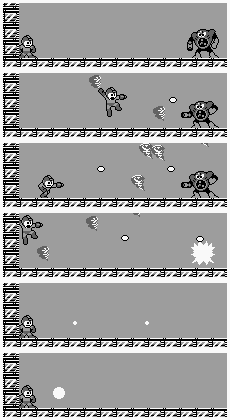 You're in complete control of the game, you should be showing that as much as you can. If you have to slow down, stop, or perform some required action that might look sloppy, try to make it obvious that it is entirely your choice to do so.
Be unexpected
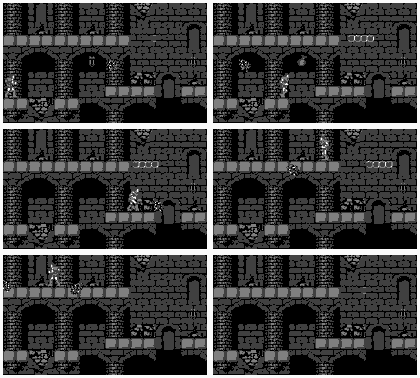 Even when you're being deliberate in your actions, you should always be looking for unexpected ways to perform them. Part of the appeal of a TAS is its ability to do things beyond the skills of an average human, so utilize your full knowledge of the game to do things that nobody would ever expect to be possible.
In essence, every game is a puzzle when you're TASing it. Find brand new routes or shortcuts, or find ways to make older and slower routes faster. Instead of finding your way around obstacles, try and find ways through them. Find uses for things that most people think are useless. Set up impossible situations and then overcome them with ease.
Be interesting
 If you have the choice, try to do things in a more impressive way than the easy way. If enemies are hard to kill, kill them. If an otherwise unnecessary object is hard to miss, miss it. If you can avoid taking damage without wasting time, do so. In places where you need to wait such as autoscrollers or timer-dependent events, don't just stand still; jump around, do special moves, dance to the music, anything that makes the delay as interesting as possible.
Keep the run watchable, though. Avoid shakey camera movements, annoying sounds, flashing lights, and overly repetitive actions unless they can't be avoided.
Be yourself
Unless you are desperate for frame optimizations, give a proper name in name entry screens... Or just sneak your name into the run anywhere you can. Leave messages for astute viewers, do something unique, leave your mark on a run in whatever way you choose.
Feedback
You may seek feedback by posting in the TASVideos forums. When posting at the forum, check if there is a previous topic on the game — it is recommended to use search. Bumping old topics (aka "necroposting") is encouraged over creating new threads, as we want to contain all information in the same place.
- To share input files, use Userfiles.
- For embedded images (you may or may not need this), use imgur.
- For scripts, use Pastebin.
- For any other files, such as AVI, consider using Dropbox, Google Drive, Mega. (These might require a sign up, though)
Remember to copy the link to the movie.
See also:
- Game Resources - on-line source of tricks in specific games
- Emulator homepages ― where to find the best emulator for making a movie
- TAS Art
- FAQ ― other answers, such as game-specific knowledge!